
Open source · MIT
Make0 Brain, on your machine.
A local MCP memory server your agents share. Offline, versioned, one SQLite file.
80 ms
per query on an Apple M2 Pro
- top-10 recall
- 92.9%
- MCP tools
- 7
- no API key
- Offline
top-10 recall
MCP tools
no API key
Why
Every agent keeps its own memory. They drift apart.
Claude has CLAUDE.md, Cursor has rules, Codex has AGENTS.md, ChatGPT has its memory page. You explain your stack and last week's decisions again in each one. Make0 Brain is one memory they all share.
Tell one agent, every agent knows
A fact saved from Cursor is found by Claude Code in its next session. No more re-explaining your stack in every app.
Nothing is overwritten silently
Every edit, from any agent, is kept as a version with who wrote it and when.
It stays yours
One SQLite file on your machine, MIT licensed, exportable to plain Markdown.
Quick start
Three commands.
Connect your agents
init finds Claude Code, Claude Desktop, Cursor, Windsurf, VS Code, Codex CLI and Gemini CLI, backs up each config, adds Make0 Brain and writes a short "search Brain first" rule. Restart the apps afterwards.
Bring in the context you already have
Agent rule files, an Obsidian vault or any Markdown folder, or a memory dump pasted from ChatGPT.
Look at it
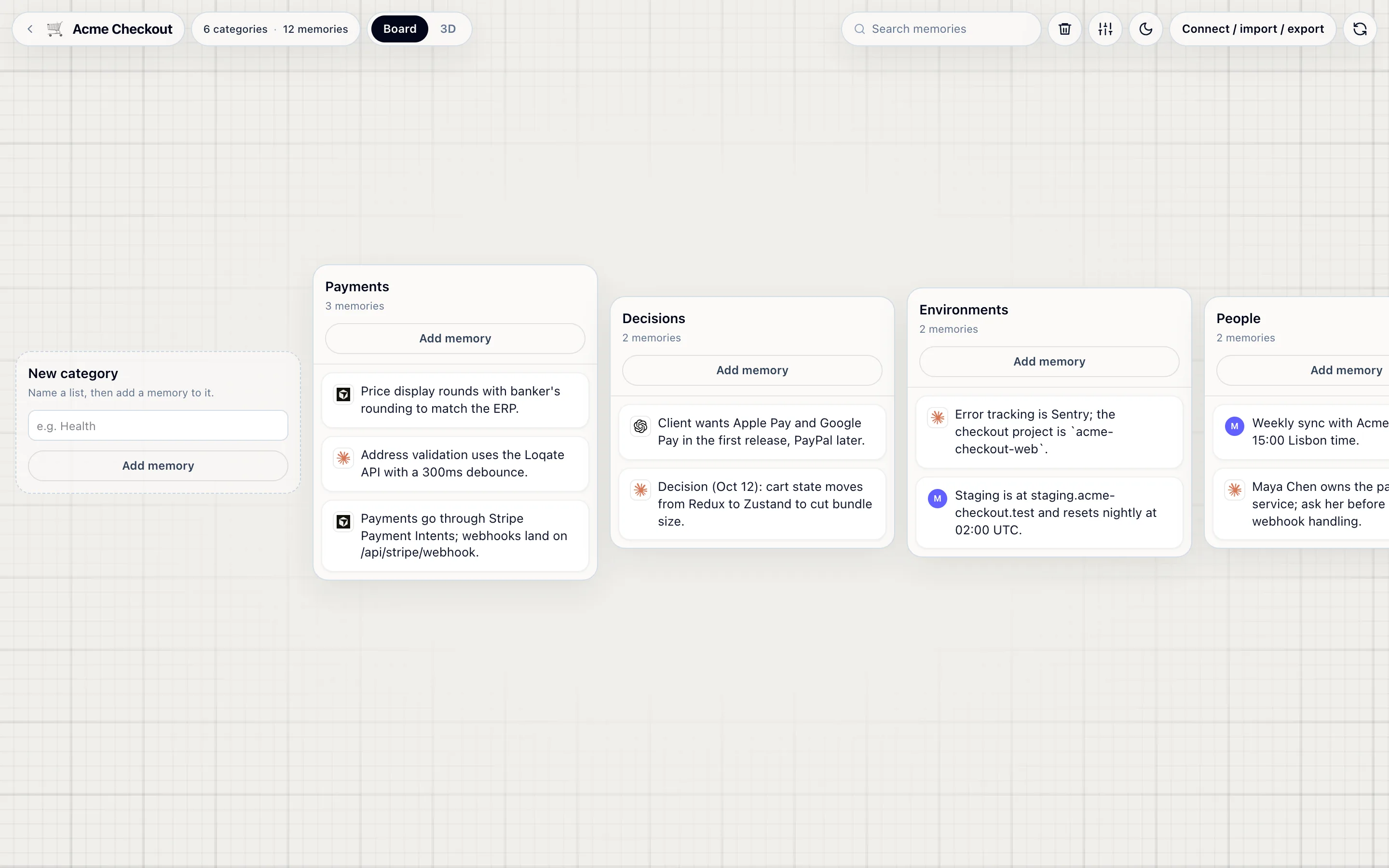
A local viewer on 127.0.0.1 shows every brain, its memories as a board or in 3D, and what each app read and wrote this week.
Models live in ~/.make0/models (about 50 MB, downloaded once) and data in ~/.make0/brain.db.
Same tools in every app
7 tools. Identical to Make0 Cloud.
After init, every connected agent gets the same tools. Names and schemas match the hosted Brain, so a prompt or agent setup works against either one. Each memory records the app that wrote it, so you can see which agent learned what.
Keep projects apart with more than one brain. An app only sees the brains you grant it.
list_brainsGet the brain ids this app can use.search_brainFind memories for a focused query before answering.get_memoryRead one memory in full.get_memory_versionsRead every saved version of a memory, newest first.add_memorySave a fact or a short Markdown note.update_memoryChange a memory. The previous text is kept as a version.delete_memoryArchive a memory. Its versions are kept and you can restore it.Memory versioning
Every write is a version. Nothing is overwritten in place.
Agents see a version count in search results and can read the full history, for example that you switched from npm to pnpm last month and which agent recorded it.
$ npx @make0-ai/brain init
Found 4 agents: Claude Code, Cursor, Codex CLI, Gemini CLI
✓ Added make0-brain to 4 configs (backups kept)
✓ Local models ready ~50 MB, once
$ npx @make0-ai/brain history mem_8f2
* v3 2026-10-27 claude
The project uses pnpm and Node 22.
v2 2026-10-20 cursor
The project uses pnpm.
v1 2026-10-02 user
The project uses npm.
Nothing is lost
update_memory or a viewer editA new current version. Older versions stay.A contradicting or merged memoryThe older memory is archived with all its versions.delete_memoryArchived: hidden from search, versions kept.Re-import of an edited noteA new version of that memory, not a duplicate.make0-brain purge <id> --yesThe only permanent delete. Agents can't do it.Context stays consistent
A memory that cleans up after itself.
Contradictions replace older facts
When a newer memory contradicts an older one, the newer one wins and the older one is archived with its history.
Duplicates merge, with an API key
An LLM judge merges restatements using only words from the originals, so it can't invent facts. Without a key, duplicates are kept rather than guessed at.
Related memories are linked
Similar memories link automatically and search follows links two hops, so a project surfaces the decisions tied to it.
Local viewer
See what each app reads and writes.
Browse memories as a board or orbit them in 3D, search, edit, restore versions, and see a per-app count of memories and tokens retrieved. It runs on 127.0.0.1 only and the counters stay in your local database.
Search quality
80 ms a query. Offline, and still ahead.
Search returns in 80 ms on an Apple M2 Pro, with no network round trip. MiniLM embeddings and BM25 keyword scores are blended, a cross-encoder reranks the shortlist, weak results are pruned, and the top results are expanded two hops along memory links. Hosted Make0 adds a stronger embedder and reranker.
SOTA in open source on SWE-ContextBench Lite, with offline modelsGold session appears anywhere in the results
SWE-ContextBench Lite: 300 earlier coding sessions and 99 related issues. Local install uses the offline MiniLM embedder and ms-marco MiniLM reranker, 80 ms per query on an Apple M2 Pro. Other systems from Table 5 of the paper; "Overall" counts a hit anywhere in each system's own result list. Full benchmark
- Each note becomes a memory. Long notes split by heading; Obsidian [[wikilinks]] become links.
- --detect turns the agent rule files you already wrote into shared memory.
- Re-runs are safe: unchanged parts skip, edits become versions, deleted stays deleted.
One Markdown file per memory, which opens as an Obsidian vault and imports back in. Or a JSON bundle with every memory, version and link.
Local or cloud
Start local. Go everywhere with Cloud.
| Open source | Make0 Cloud | |
|---|---|---|
| Best for | Local agents, offline, on your machine | Every device and web app, including ChatGPT and Claude on the web |
| Setup | npx @make0-ai/brain init | Sign in at make0.ai |
| API key | None required | Make0 account |
| Brains | Personal and custom | Personal, project, and custom |
| Storage | ~/.make0/brain.db | Hosted |
| Search | MiniLM + BM25 + cross-encoder, 80 ms per query | Stronger embedder and reranker |
A one-command port from local to Make0 Cloud is coming. The export --json bundle is the format it will use, with history and attribution included.