
Make0 Brain: Portable, User-Owned Memory Shared Safely Across AI Assistants
Saurabh Singh · Make0 · October 24, 2026 · Version 1.0
Abstract
People now work across several AI assistants, and each keeps its own memory. What a user teaches one assistant is missing from the next, and no single place exists where the user can see, correct, or delete what is remembered. We argue that long-term memory should be a layer the user owns and every assistant borrows, not a feature each assistant keeps to itself, and we present Make0 Brain, a system built on that idea. Make0 keeps one memory graph per user, outside any assistant, and serves it to ChatGPT, Claude, Cursor, and Make0's own agent through the Model Context Protocol (MCP). Sharing memory makes it writable by many agents, so the design centers on safe multi-agent writes. Read and write are separate, per-brain grants. Every memory records which assistant created and last changed it. Every change becomes a version, and deletions by assistants or by the system archive the memory instead of erasing it. Assistants can add and edit memories, but only the user can restore an earlier version or delete a memory permanently, so every change any agent makes can be undone. Behind this interface, a write path keeps the shared graph clean (extraction, contradiction handling, merging, linking), and a read path combines BM25 and dense search, reranking, score gating, and graph expansion. On LoCoMo, Make0 reaches 83.64% overall accuracy in its standard configuration, above published results for Zep (79.09%), LangMem (78.05%), and Mem0 (62.47%) but below Memori (87.0%), and 92.0% in an experimental high-budget configuration, while passing 85% fewer context tokens than the full conversation. On SWE-ContextBench Lite, held out from tuning, the gold prior task appears in Make0's top 10 for 92.93% of related tasks, against 73.34% for the best published system. We are explicit that these benchmarks measure a single agent's retrieval; the benefits of sharing across assistants are argued from the design, and we give a protocol and production metrics to measure them.
Note: The paper describes Make0's architecture as of September 2026, and its benchmark numbers come from that version. Newer benchmarks are not reflected in the paper. The current architecture uses fewer context tokens with comparable overall accuracy in Standard mode; see the LoCoMo benchmark page for the latest results. On SWE-ContextBench, evaluated 25 Oct 2026, Make0 Standard returns the gold past task in the top 10 on 93.9% of Lite issues (rank 1 on 71.7%) and on 88.2% of the full set (rank 1 on 71.4%). See the SWE-ContextBench page.
Ownership
Memory you own, not memory each app keeps
One memory graph per person, outside any assistant. ChatGPT, Claude, Cursor, and the Make0 Agent read it over MCP, and you choose which assistant can see or change which brain.
Safety
Many agents can write. Every change can be undone.
Each memory and version records which assistant wrote it. Deletions by agents or by Make0 itself archive instead of erase, and only you can restore a version or delete for good.
Evidence
Measured on public benchmarks
Hybrid retrieval with reranking and graph expansion, tested on LoCoMo and on SWE-ContextBench, which was held out from tuning. Limits and open questions are stated in the paper.
Product flow
An edit in Claude, retrieved in Cursor
- 1
You correct a preference in Claude
Claude calls update_memory under its write grant.
- 2
Make0 saves a new version
Attributed to Claude. The earlier version, written by ChatGPT, is kept.
- 3
Cursor searches the next day
search_brain under its read grant, with hybrid retrieval and reranking.
- 4
Cursor gets the current version
With who wrote it and how many versions exist, and writes copy that respects the correction.
- 5
You can undo it in one place
Restore the earlier version in your Brain, and every assistant sees it on its next search.
Results
On LoCoMo, Make0 Standard is above published results for Zep, LangMem, and Mem0 and below Memori and the full-context reference. Baselines are published numbers produced with different answer and judge models, so the gaps are indicative. These benchmarks measure a single agent's retrieval; the paper argues the benefits of sharing across assistants from the design and gives a protocol to measure them.
Architecture
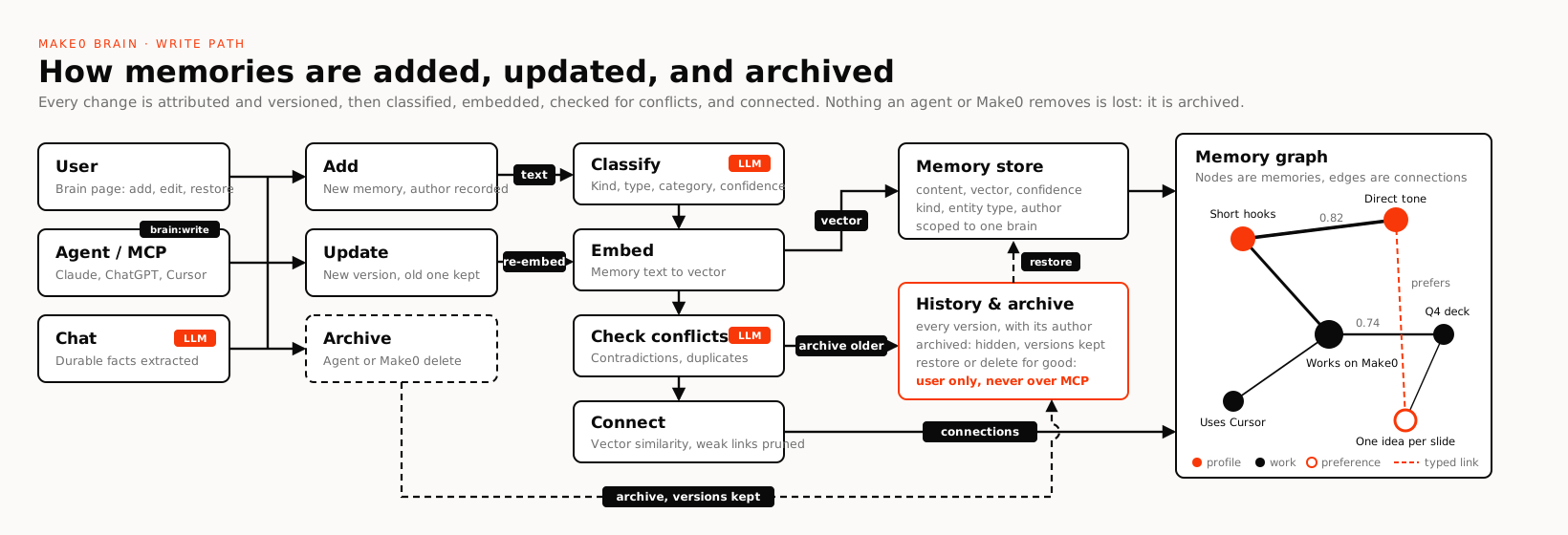
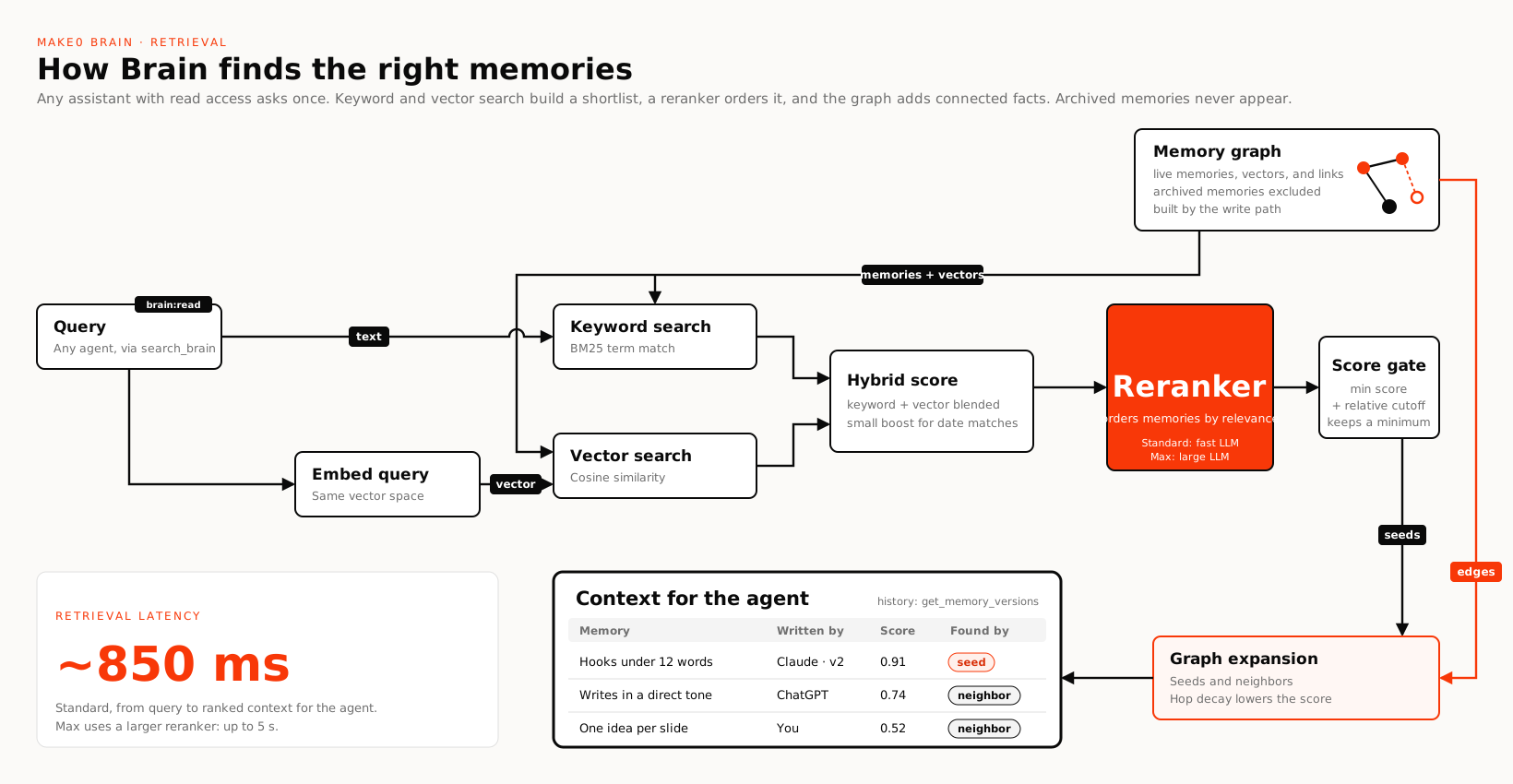
What's in the paper
- Memory model: typed memories, typed edges, provenance, versions, archive state
- Write path: conservative extraction, an LLM pair judge for merges and contradictions, linking
- Read path: cosine similarity, BM25 with per-brain IDF, hybrid scoring, reranking, graph expansion
- Versions and archive: many writers, one history, user-only restore
- Evaluation on LoCoMo and SWE-ContextBench, including context cost
- Limitations, and a protocol for measuring cross-assistant benefits directly
Cite this paper
Singh, S. (2026). Make0 Brain: Portable, User-Owned Memory Shared Safely Across AI Assistants (Version 1.0) [Preprint]. Zenodo. https://doi.org/10.5281/zenodo.23610847
Published on Zenodo under CC BY 4.0. The LaTeX source is available with the Zenodo record.
 Your Brain
 Cursor
 Grok Bot